September 11, 2026 · Varun Sharma
HIPAA-Oriented Patient Management Platform
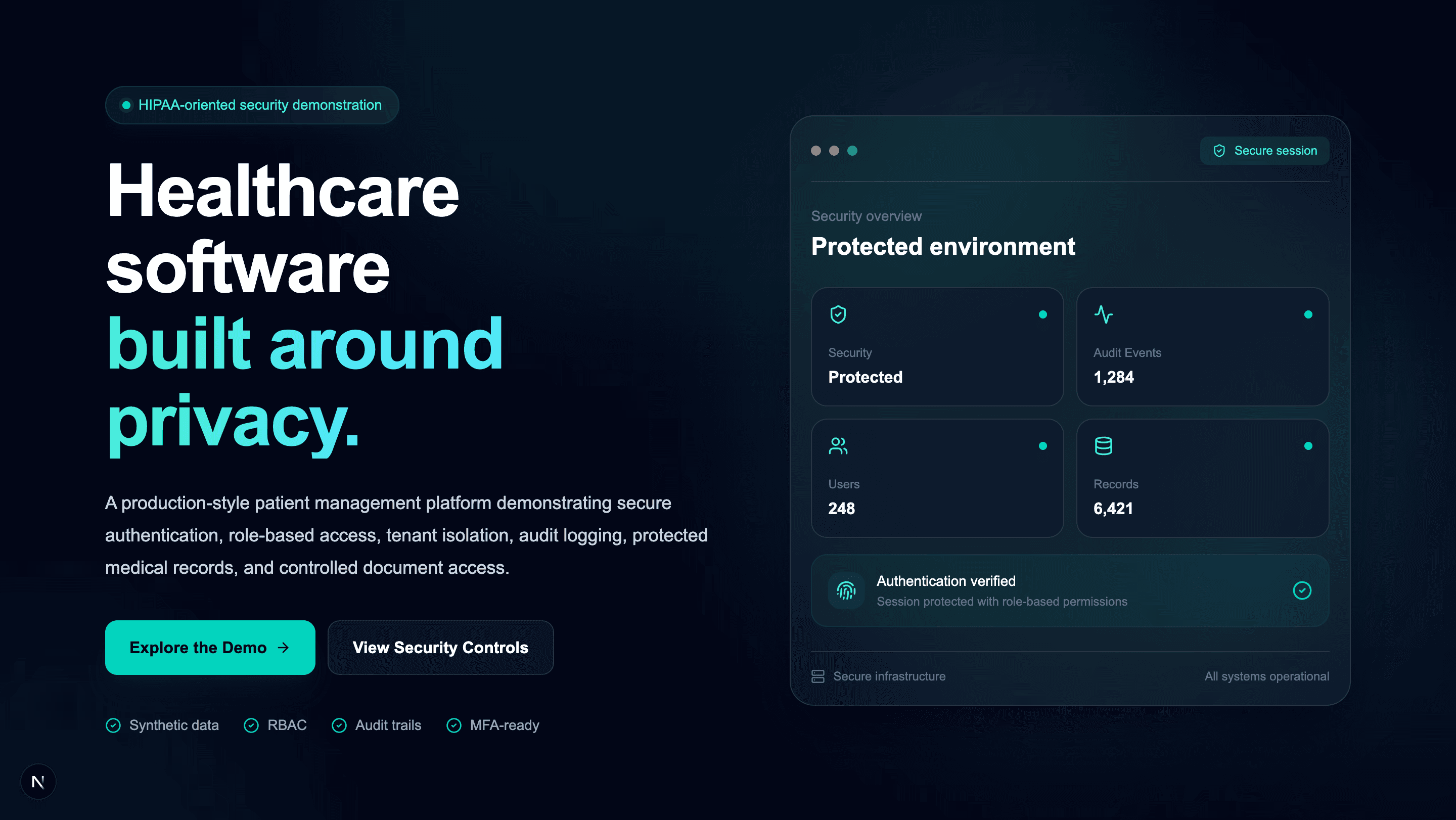
The HIPAA-Oriented Patient Management Platform is a secure healthcare SaaS application designed to help healthcare organizations manage patients, providers, users, and sensitive healthcare records within a structured and access-controlled environment.
The platform was designed around privacy, security, tenant isolation, role-based access control, and auditability — providing a foundation for healthcare organizations to manage patient information while maintaining strict control over who can access sensitive data.
I worked on the development of the platform as a Full-Stack Developer, building the core application architecture, authentication, authorization, organization-level data isolation, patient management workflows, and security-focused functionality.
The Challenge
Healthcare applications handle highly sensitive patient information and require stronger controls than conventional business applications.
The platform needed to address several challenges:
Protect sensitive patient information
Separate data between healthcare organizations
Control access based on user roles
Allow providers to manage relevant patient information
Prevent unauthorized users from accessing restricted records
Maintain an audit trail of important activities
Support disabled and suspended user accounts
Provide administrators with centralized organization management
Create a scalable foundation for future healthcare workflows
The goal was to build a healthcare-focused SaaS architecture where security and privacy were considered from the application design stage, rather than added as an afterthought.
Solution
I helped build a centralized patient management platform using a security-focused architecture.
The application uses organization-level tenant isolation to ensure that users primarily interact with data belonging to their organization.
A role-based permission model provides different levels of access for:
Super Administrators
Organization Administrators
Healthcare Providers
Patients
The architecture combines authentication, authorization, organization scoping, audit logging, and controlled data access to create a secure foundation for healthcare software.
Key Features
Secure Authentication
The platform includes an authentication system designed to provide controlled access to healthcare application resources.
User accounts are associated with organizations and roles, allowing the application to determine what functionality and information each user should be able to access.
Account status management also supports states such as:
Active
Disabled
Suspended
This provides administrators with greater control over account lifecycle and access.
Role-Based Access Control
Different healthcare users require different levels of access.
The platform implements role-based access control for:
Super administrators
Organization administrators
Providers
Patients
Permissions are applied throughout the application so users can only access functionality appropriate to their role.
This creates a clear authorization boundary between administrative functionality, provider workflows, and patient-facing information.
Multi-Tenant Organization Isolation
A key part of the architecture is organization-level data isolation.
Healthcare organizations operate as separate tenants, with users and patient records associated with their respective organizations.
Application queries and backend workflows are designed around the authenticated user's organization context to reduce the risk of cross-organization data access.
This provides an important foundation for a multi-tenant healthcare SaaS platform.
Patient Management
The patient management module provides healthcare organizations with a centralized way to manage patient records.
Authorized users can access patient information based on their organization and assigned permissions.
The architecture also allows patient records to be associated with relevant providers, creating a foundation for provider-specific patient workflows.
Provider Management
Healthcare providers can be associated with patients within the organization.
This allows the platform to support workflows where providers need access to patients under their care while maintaining organization-level access boundaries.
Provider assignment also creates a foundation for future healthcare functionality such as appointments, clinical workflows, notes, and patient-provider communication.
Audit Logging
Healthcare applications require visibility into important system activity.
The platform includes an audit-oriented architecture for recording important actions performed within the application.
Audit events can be used to track activities such as:
User actions
Record access
Record creation
Record updates
Administrative operations
Permission-related activities
This provides organizations with greater visibility into application activity and creates an important foundation for security investigations and compliance processes.
Organization Management
Organization administrators can manage their organization's users and healthcare workflows from a centralized environment.
The organization structure provides a clear boundary between:
Organization → Users → Providers → Patients
This makes the platform suitable for supporting multiple healthcare organizations within a SaaS architecture.
Secure Data Access
The backend was designed so that sensitive records are not simply exposed based on frontend visibility.
Authorization and organization-level restrictions are applied at the application layer, ensuring that security decisions are enforced server-side.
This helps prevent scenarios where a user could bypass frontend restrictions and directly access unauthorized records through an API request.
Healthcare-Focused Dashboard
The platform provides role-specific dashboards designed around the responsibilities of each user.
Administrators can manage organizational resources, while providers can work with their assigned patients.
The architecture allows additional healthcare modules to be added without restructuring the core authentication and authorization system.
Security-Focused Architecture
Security was one of the primary considerations throughout the application architecture.
The platform was designed around several important principles:
Least-Privilege Access
Users should only receive the permissions required for their role and responsibilities.
Tenant Isolation
Organization identifiers are used throughout the data model and backend workflows to separate tenant data.
Server-Side Authorization
Sensitive access decisions are enforced on the server rather than relying solely on frontend controls.
Auditability
Important application activity can be recorded to provide visibility into who performed specific actions.
Account Lifecycle Management
Administrators can control account status and disable access when required.
Controlled Patient Access
Patient records can be associated with organizations and providers to support more granular access workflows.
My Contribution
As the Full-Stack Developer, I worked across the application's frontend, backend, database architecture, and security-focused functionality.
My contribution included:
Designing application architecture
Developing authentication workflows
Implementing role-based access control
Building organization-level tenant isolation
Developing patient management functionality
Implementing provider management
Building organization management workflows
Designing database relationships
Implementing audit logging
Developing secure API endpoints
Implementing server-side authorization
Building role-specific application workflows
Managing user account statuses
Developing responsive dashboard interfaces
Implementing validation and error handling
Optimizing database queries and application performance
The project required particular attention to the relationship between users, organizations, providers, and patients, ensuring that application functionality remained aligned with the security model.
Technology Stack
Framework: Next.js
Backend: Next.js API / Server-side architecture
Database: PostgreSQL
ORM: Prisma
Frontend: React, Tailwind CSS
Authentication: Secure application authentication
Authorization: Role-Based Access Control (RBAC)
Architecture: Multi-tenant SaaS
Security: Organization-level data isolation, server-side authorization, audit logging
Result
The result was a healthcare-focused SaaS foundation designed around secure patient management and organization-level data isolation.
The platform provides a structured environment for healthcare organizations to manage users, providers, and patients while maintaining role-based access controls and an auditable application architecture.
Its modular architecture also provides a foundation for extending the product with additional healthcare capabilities such as:
Appointments
Clinical notes
Medical records
Patient documents
Provider workflows
Patient communication
Notifications
Reporting
Advanced audit and compliance controls
Technical Highlights
The project went beyond basic patient CRUD functionality and focused on building the security foundation required for healthcare software.
Key technical areas included:
Multi-tenant healthcare architecture
PostgreSQL data modeling
Prisma ORM
Next.js application architecture
Role-based access control
Organization-level tenant isolation
Provider-patient relationships
Server-side authorization
Audit logging
Secure API design
User lifecycle management
Sensitive record access controls
Scalable healthcare SaaS architecture
Conclusion
The HIPAA-Oriented Patient Management Platform demonstrates how a healthcare SaaS application can be designed with privacy, security, authorization, and tenant isolation at its core.
As the Full-Stack Developer, I worked on the architecture and implementation of authentication, RBAC, organization isolation, patient and provider management, audit logging, and secure backend workflows.
The project provided a strong technical foundation for building privacy-focused healthcare applications and expanding into more advanced patient and provider workflows.