September 11, 2026 · Varun Sharma
BrainSimResearch: AI Powered Injury Prediction Analytics Platform
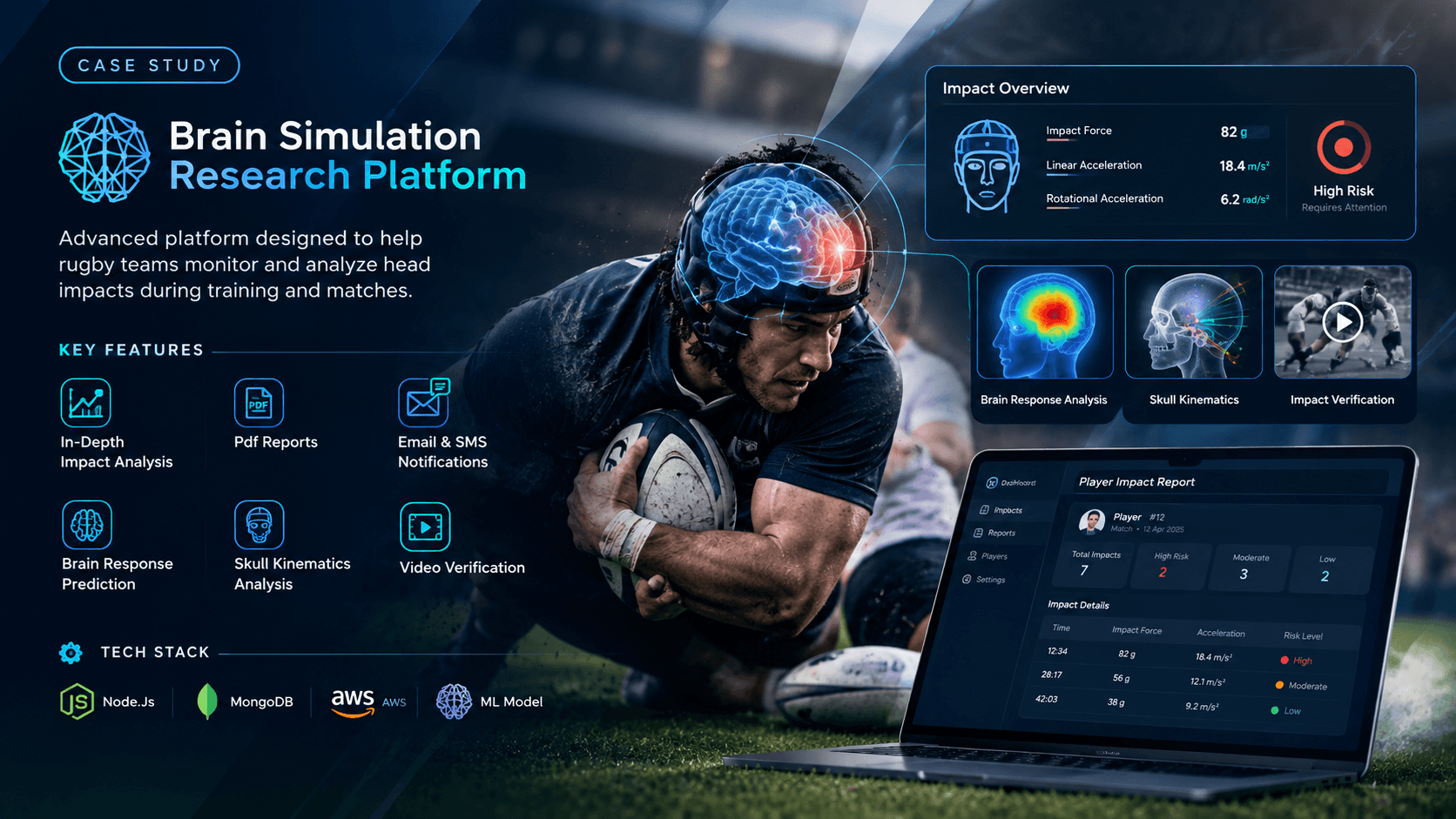
BrainSimResearch is an AI-powered injury prediction and analytics platform designed to help researchers analyze brain response to impacts and overpressures using computational modeling, sensor data, and advanced analytics.
The platform brings together complex simulation data, biomechanical information, computational models, and research workflows into an interactive web-based environment.
I worked on the platform as a Full-Stack Developer, contributing to the development of the web application, backend APIs, data processing workflows, visualization, cloud infrastructure, and integration of computational injury-prediction systems.
The platform was built to make complex brain simulation and injury-related data more accessible to researchers and other technical stakeholders.
The Challenge
Brain injury research involves large and complex datasets generated from simulations, sensors, and computational models.
Researchers need to process and understand information such as brain response, impact characteristics, biomechanical measurements, and simulation results.
Some of the key challenges included:
Processing large simulation datasets
Handling computationally intensive workloads
Connecting simulation and prediction systems with a web application
Making complex scientific data easier to visualize
Providing researchers with an intuitive analytics interface
Supporting scalable cloud-based computation
Managing large volumes of research data
Generating meaningful reports and insights
Creating a reliable platform for research workflows
The goal was to build a software platform that could bridge the gap between complex computational research and a practical user interface.
Solution
I helped develop a centralized research and analytics platform that connects the frontend application with backend APIs, computational processing, and cloud-based infrastructure.
The platform allows users to interact with research data through dashboards and visualization tools while computational workloads are processed through backend services.
The architecture was designed to separate the interactive web application from computationally intensive processing, allowing the system to scale as simulation workloads increase.
AI & Injury Prediction
A major component of the platform is the use of computational modeling and machine-learning-based analysis to understand how the brain responds to impacts.
BrainSim's technology uses numerical simulations to model brain response to impact and overpressure, with its technical architecture incorporating full-physics three-dimensional finite-element modeling and deep-learning algorithms.
The software platform provides the surrounding infrastructure required to work with these computational models, including data ingestion, processing, visualization, analytics, and reporting.
The system is designed to help researchers move from raw impact or simulation data toward interpretable insights about brain response.
Advanced Brain Simulation
The platform supports workflows around computational brain simulation and impact analysis.
Simulation outputs can contain large amounts of complex numerical data, requiring efficient processing and visualization.
The application provides researchers with an interface for accessing simulation results and analyzing relevant brain-response metrics.
The underlying research platform is designed around scalable computation and rapid brain-strain prediction workflows.
High-Performance Cloud Processing
Computational brain simulations can require significant processing resources.
I worked on integrating the application with cloud-based computational infrastructure so intensive workloads could be processed independently from the main web application.
This architecture provides a foundation for:
Large-scale simulations
Distributed processing
Computational workloads
Background processing
Large dataset handling
Scalable research workflows
Separating computational workloads from the interactive application also helps keep the user experience responsive while complex calculations are running.
Data Visualization & Analytics
One of the key challenges was making complex simulation results easier to understand.
I worked on interactive dashboards and visualization interfaces that allow users to explore simulation and injury-related data.
The platform can present information such as:
Impact metrics
Brain response data
Simulation outputs
Biomechanical measurements
Injury-related analytics
Comparative results
Research datasets
The visualization layer transforms large amounts of technical data into a more accessible research interface.
Sensor Data Integration
The platform is designed to work with data originating from sensors and other impact-monitoring systems.
BrainSim's broader platform describes the use of wireless wearable sensors to provide impact data for brain-response analytics.
The software architecture provides a pathway for bringing sensor-generated information into the analytics workflow, where it can be processed and analyzed alongside computational models.
Research Dashboard
The research dashboard provides a centralized workspace for accessing simulation and analytics information.
Researchers can use the interface to:
Review simulation results
Analyze impact information
Compare datasets
Explore visualization outputs
Monitor processing workflows
Access research reports
The dashboard was designed to reduce the complexity of working directly with raw computational data.
Reporting & Data Analysis
The platform also supports research reporting and analysis workflows.
Users can work with simulation results and generate structured information that can be used for further analysis, comparison, and research documentation.
This provides a bridge between computational processing and practical research workflows.
Scalable Architecture
The platform required an architecture capable of handling both interactive web requests and computationally intensive processing.
The system was structured around separate application responsibilities, including:
Frontend
Interactive dashboards, data visualization, research workflows, and user interfaces.
Backend
APIs, authentication, data management, business logic, and communication with processing services.
Processing
Computational workloads, data transformation, simulation processing, and injury-prediction workflows.
Cloud Infrastructure
Scalable infrastructure for handling computational workloads and large datasets.
This separation allows the platform to evolve as simulation complexity and research requirements increase.
My Contribution
As a Full-Stack Developer, I worked across the application's frontend, backend, data-processing workflows, and infrastructure.
My contribution included:
Developing interactive web interfaces
Building frontend dashboards
Developing backend APIs
Integrating computational services
Implementing data visualization
Building research workflows
Working with large datasets
Supporting simulation-processing workflows
Implementing authentication and user management
Optimizing application performance
Supporting cloud infrastructure
Integrating sensor and research data
Developing reporting functionality
Debugging and maintaining production systems
Collaborating with researchers to translate technical requirements into software workflows
A significant part of the work involved translating complex scientific and engineering requirements into interfaces that researchers could actually use.
Technology Stack
Frontend: React
Backend: Node.js
Data Processing: Python
AI / Machine Learning: Computational models and deep-learning-based analysis
Cloud: AWS / Cloud Computing
APIs: REST APIs
Analytics: Interactive data visualization and research dashboards
Domain: Computational Neuroscience, Biomechanics, Injury Prediction
Result & Impact
The resulting platform provides researchers with a centralized environment for working with brain simulation and injury-related analytics.
Instead of interacting directly with complex computational outputs and raw datasets, users can access research information through an intuitive web interface.
The platform helps provide:
Faster Research Workflows
Cloud-based processing and automated workflows help researchers work with computational results more efficiently.
Better Data Accessibility
Complex biomechanical and neurological datasets can be explored through interactive visualizations and dashboards.
Scalable Computation
The architecture provides a foundation for handling computationally intensive workloads as research requirements grow.
Improved Research Collaboration
A centralized platform makes it easier for research teams to access, analyze, compare, and share simulation results.
Data-Driven Injury Analysis
Computational models, sensor information, and analytics can be combined to provide deeper insight into how impacts affect the brain.
Technical Highlights
The project required more than conventional SaaS development.
Key technical areas included:
AI-powered analytics
Computational brain modeling
Injury prediction workflows
Large-scale data processing
Cloud-based computation
Sensor data integration
Interactive scientific visualization
REST API development
React application development
Node.js backend development
Python data-processing workflows
Research reporting
Scalable infrastructure
Performance optimization
Conclusion
BrainSimResearch demonstrates how modern software engineering can support advanced neuroscience and injury research.
By combining React, Node.js, Python, cloud computing, computational modeling, sensor data, and interactive analytics, the platform provides a bridge between complex scientific computation and practical research workflows.
As a Full-Stack Developer, I contributed to the development of the web application, APIs, data-processing workflows, visualization systems, and cloud infrastructure required to turn complex brain-simulation research into an accessible digital platform.
The project was a strong example of building software at the intersection of AI, computational neuroscience, biomechanics, cloud computing, and data analytics.