September 11, 2026 · Varun Sharma
EvoShield SMG: Most Innovative Gear
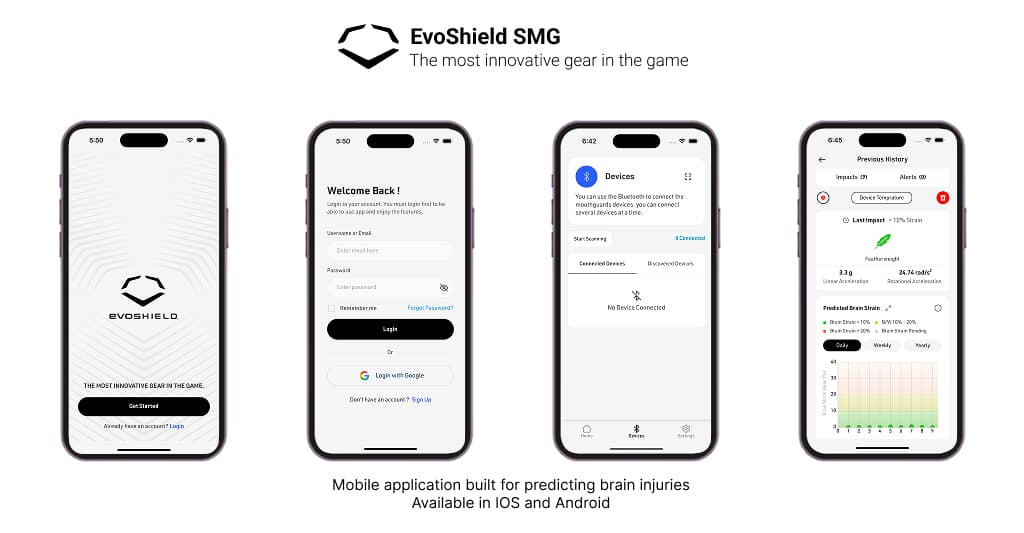
EvoShield SMG is an advanced sports technology platform designed to help predict and analyse head injuries caused by impacts during sports activities.
I worked across the web application, backend APIs, and hybrid mobile application, building the technology that connects wearable hardware with real-time sports data and advanced injury analysis.
The platform combines a sensor-enabled wearable mouthguard, Bluetooth Low Energy communication, mobile technology, web applications, and backend services to create a complete ecosystem for monitoring and analysing head impacts.
The Challenge
Head impacts in contact sports can happen within milliseconds, making it difficult to understand the severity and potential consequences of an impact using traditional observation alone.
The goal of EvoShield SMG was to create a technology platform that could collect detailed impact information from a wearable mouthguard and turn that data into meaningful insights.
This required building more than a mobile application.
The platform needed to connect physical wearable hardware with mobile devices, transfer sensor data reliably, process and expose that data through APIs, and provide a web-based interface for deeper analysis.
The Solution
I worked on building the complete software ecosystem behind EvoShield SMG.
The platform consists of three major components:
A web application for viewing and analysing impact information
A Node.js backend and API layer for processing and delivering platform data
A React Native hybrid mobile application for communicating with the wearable mouthguard
The mobile application acts as an important bridge between the physical wearable device and the cloud-based platform.
Wearable Mouthguard & Nordic BLE
One of the most technically challenging parts of the project was connecting the mobile application to the wearable mouthguard.
The mouthguard contains sensors capable of capturing information related to impacts experienced by an athlete.
I integrated the wearable with the React Native application using a Nordic Bluetooth Low Energy module.
This allowed the mobile application to communicate with the wearable, establish the connection, receive sensor information, and transfer the collected data into the wider EvoShield platform.
Working with BLE required handling real-world connectivity conditions, device discovery, connection states, data transmission, synchronization, and communication between the wearable hardware and mobile application.
Head Injury Prediction
The core purpose of EvoShield SMG is to help predict and analyze head injuries resulting from impacts during sports sessions.
The platform collects data from the wearable mouthguard and makes that information available for deeper analysis.
This allows the system to go beyond simply recording that an impact occurred.
The platform can be used to analyze impact information and provide a more detailed understanding of what happened during a sporting session.
Impact Analysis
The platform provides detailed analysis around recorded impacts.
Impact information can be reviewed to help understand the characteristics of an event and identify potentially significant impacts.
The system is designed to bring together sensor information and analytical results in a format that can be used by sports professionals and other users responsible for monitoring athletes.
Web Application
I developed the web application using React.
The web interface provides users with a centralized environment for accessing player information, reviewing impact data, and analyzing results generated by the platform.
The application was designed to handle complex sports and sensor data while keeping the user experience clear and practical.
The web application acts as the main analytical interface of the platform, giving users a broader view of information collected from connected wearable devices.
Backend APIs
The backend was built using Node.js.
I developed APIs responsible for connecting the different parts of the EvoShield ecosystem.
The backend provides the infrastructure required to:
Receive and process application data
Provide data to the web application
Support the mobile application
Manage player and session information
Store and retrieve impact-related data
Connect the wearable-data workflow with the wider platform
Support analysis and reporting workflows
The API architecture allowed the web and mobile applications to work as different interfaces on top of the same underlying platform.
React Native Mobile Application
The mobile application was built using React Native to support both iOS and Android.
The application plays a critical role in the wearable-data pipeline.
It connects to the mouthguard through the Nordic BLE module and acts as the communication layer between the wearable device and the backend platform.
Using React Native allowed the project to maintain a shared cross-platform application while still interacting with native Bluetooth capabilities.
Data Flow
The overall platform can be viewed as a connected data pipeline:
Wearable Mouthguard → Nordic BLE → React Native Mobile App → Backend APIs → Web Application → Impact Analysis
This architecture allows physical impact data collected by the wearable device to move through the platform and become accessible through the web application.
Each layer has a specific responsibility, from capturing sensor information to presenting meaningful results to the end user.
PDF Reports
The platform also supports generating detailed PDF reports based on collected and analyzed data.
These reports provide a convenient way to document impact information and share results outside of the web application.
This is particularly useful when teams or professionals need a structured record of an athlete's activity or impact history.
Notifications
The platform includes notification workflows for important events.
Email and SMS notifications can be used to communicate relevant information to users when specific conditions or events occur.
This makes the platform more proactive rather than requiring users to constantly monitor the dashboard.
Brain Response Prediction
One of the advanced capabilities of the platform is brain response prediction.
The system combines collected impact information with analytical models to help provide insight into how an impact may affect the athlete.
This creates a more sophisticated approach to sports impact monitoring than simply counting or recording collisions.
Skull Kinematics & Video Verification
The platform also incorporates skull kinematics and video verification as part of the impact analysis workflow.
Combining sensor data with additional verification provides a richer understanding of an impact event and helps users analyze what happened during a sporting session.
This combination of wearable sensor technology, analytics, and video provides a more comprehensive approach to understanding head impacts.
Technology Stack
Web Application
React
JavaScript / TypeScript
REST APIs
Data visualization
Responsive web interface
Backend
Node.js
REST APIs
Data processing
Authentication and application services
Database integration
Mobile
React Native
iOS
Android
Nordic BLE
Bluetooth Low Energy
Native device communication
Platform
Wearable Mouthguard
Sensor Data
Head Impact Analysis
Brain Response Prediction
Skull Kinematics
Video Verification
PDF Reports
Email Notifications
SMS Notifications
My Role
I worked across multiple parts of the EvoShield SMG platform rather than focusing only on the mobile application.
My work included:
React web application development
Node.js backend development
REST API development
React Native mobile application development
Nordic BLE integration
Wearable mouthguard connectivity
Sensor-data workflows
Impact-data processing
Dashboard development
Reporting functionality
Mobile and web integration
Working across the web, backend, and mobile layers allowed me to understand and contribute to the complete data flow from the physical wearable device to the final analytical interface.
The Result
EvoShield SMG became a complete connected sports technology platform that brings together wearable hardware, mobile applications, backend APIs, web technology, and advanced impact analysis.
The platform creates a continuous workflow from the athlete wearing the sensor-enabled mouthguard to the collection of impact data, backend processing, analysis, visualization, reporting, and notifications.
The combination of React, Node.js, React Native, and Nordic BLE allowed me to build the software layer connecting the physical wearable device with the wider digital platform.
What Made This Project Special
EvoShield SMG was one of the most technically interesting projects I have worked on because it required solving problems across multiple layers of technology.
It wasn't just a website.
It wasn't just a mobile application.
It wasn't just an API.
It was a complete connected platform where hardware, mobile software, backend infrastructure, web applications, sensor data, analytics, and predictive technology all had to work together.
The most challenging part was creating a reliable bridge between the physical wearable mouthguard and the digital platform.
Using Nordic BLE with React Native, I helped establish that connection and built the software infrastructure required to move information from the wearable device into the platform where it could be analyzed and visualized.
Project Details
Industry: Sports Technology / Wearable Technology
Platform: Web, iOS & Android
Web: React
Backend: Node.js
Mobile: React Native
Hardware Communication: Nordic BLE / Bluetooth Low Energy
Core Technology: Wearable Sensors, Head Impact Analysis, Brain Response Prediction, Skull Kinematics and Video Verification
Key Features: Impact Monitoring, Player Dashboard, PDF Reports, Email Notifications, SMS Notifications, Wearable Connectivity
Live Application
Google Play: EvoShield SMG
Apple App Store: EvoShield SMG